

By Ara Layseca
October 22, 2026
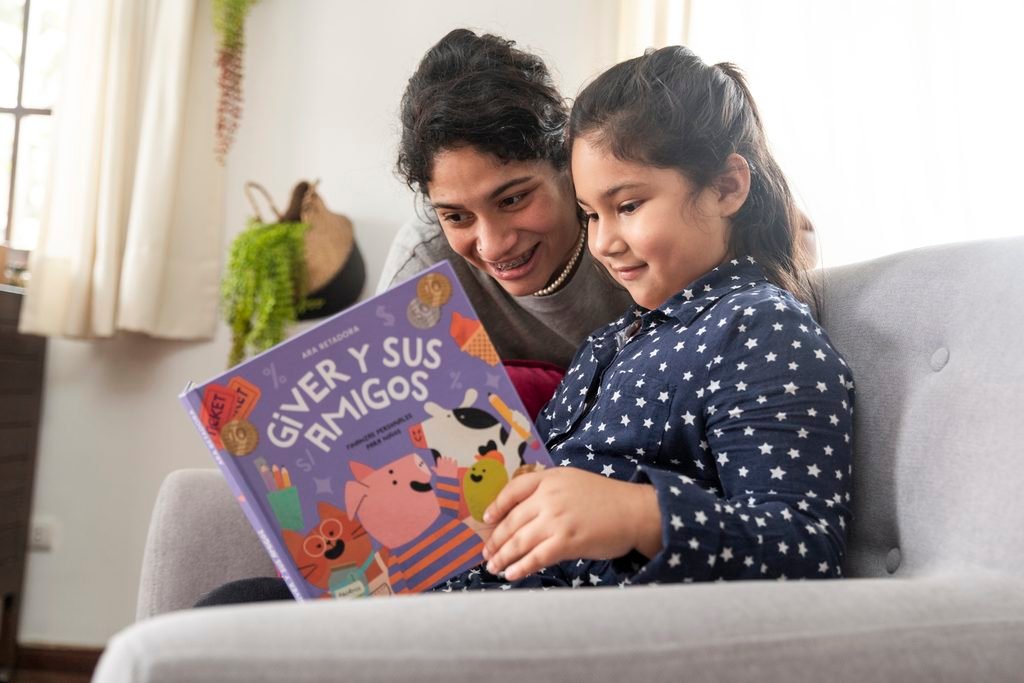
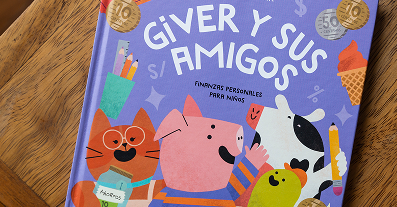
Photo of our first book, Giver y sus amigos (Giver and His Friends). On sale on our website and at Crisol bookstores.
What do we do after reading a story about money with our children or students?
This is a question we ask ourselves a lot at Edufina.
Because we believe a financial education book should not stop at the reading.
A child can read that Giver saves, that Muchi discovers her talents, that Toru learns to be patient or that Catu organizes her money into different little jars.
But the real learning happens when that child can ask themselves:
What would I do?
That is where financial education begins.
That is why, in this article, we want to share some ideas so that Giver y sus amigos can become a tool for conversation, reflection and practice both at home and in the classroom.
Giver y sus amigos is a financial education book designed to accompany children aged 6 to 11, according to the review carried out for the book by clinical psychologist Vania Bayona.
This stage is especially interesting because children begin to develop more autonomy and can understand that their decisions have consequences.
And that is exactly what we aim to work on with Giver and his friends.
We do not want them to learn only definitions such as “saving,” “income” or “spending.”
We want them to start building criteria for making decisions.
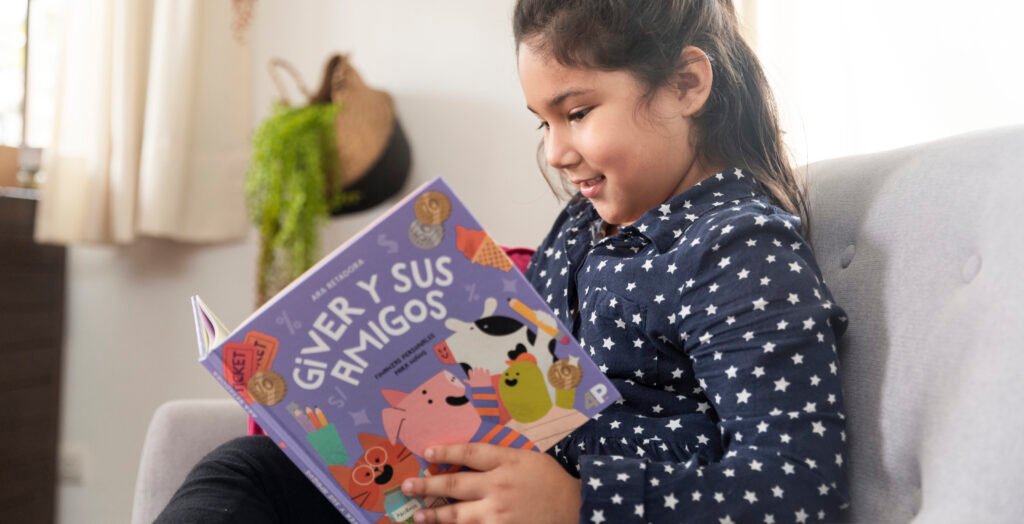
When we created Giver y sus amigos, we wanted to talk about personal finance in a way that is close to children’s world.
That is why the book starts with everyday situations:
What do I like?
What do I need?
What makes me happy?
What can I do?
What do I want to achieve?
What do I do when I receive money?
From those questions, financial concepts appear.
But beneath each concept there is also a skill and a value we want to help develop.
Before talking about how to manage our money, we need to know ourselves.
In the first pages, Giver tells us what he likes, what his favorite day is and what he needs to do the things he enjoys. The book also invites children to recognize their own tastes, preferences and needs.
Because our financial decisions are related to who we are, what we value and what we want to achieve.
Giver is the saver of the group, but he also learns to organize what he receives.
When he receives his allowance, he has to decide what to do with it and sets different priorities. He even uses a poster board to organize his responsibilities.
This way, financial education connects with something children can experience every day:
organizing their belongings, their time, their responsibilities and their resources.
Talking about needs and wants is an opportunity to pause and look at everything that is already part of our lives.
What do we really need?
What do we want just because we like it?
Is there a difference?
The book invites children to look at their own lives before making decisions about what to buy or what to do with their money.
Our relationship with money does not have to be built only around accumulating.
We can also talk about giving, sharing and being grateful.
In the story, Giver sets aside part of what he receives to help others, while Catu learns to distribute her money among different purposes: saving, giving and using it to fulfill her wishes.
This lets us talk with children about a very important question:
What can we do with our resources so that they also have a positive impact on other people?
Toru represents another fundamental lesson: we cannot always have what we want right away.
The book invites us to understand that waiting, saving a little longer and postponing a decision can let us reach something we value more. At the end of the story, Toru reminds us precisely of the importance of being patient.
This ability to wait is an important part of learning to make financial decisions.
You don’t need to turn the reading into a finance class. You can start simply by reading a story and asking a few questions.
The key is to move from:
reading → talking → experimenting.
And to do that, we want to share three teaching tools that can help.
One of the best ways to learn about money is to experience it in real, age-appropriate situations.
This approach, known as learning by doing, aims for learning not to stay in theory but to be put into practice.
This fits very well with the approach of Giver y sus amigos.
For example, after reading how Giver organizes his allowance, you can ask your child:
“If you received S/10 today, what would you do with it?”
There is no need to look right away for a “correct” answer.
We can let them think.
Let them make a proposal.
Let them make a mistake.
Let them change their mind.
Let them discover what happens when they make a decision.
The book itself proposes that children experiment with their resources. For example, Catu receives S/20 and uses three jars to distribute it among different goals.
You can take three transparent jars, envelopes or containers and let the child decide what each one represents.
For example:
SAVE
For a future goal.
ENJOY
For something they want to buy or do.
GIVE
To share or help someone.
It doesn’t matter so much how much money there is.
What matters is that the child has the opportunity to make a decision and see its consequences.
Another interesting tool is the educational contract.
The idea is simple:
Instead of us adults saying: “Now you’re going to learn about saving.“
Father, mother, teacher and child can build a small agreement together:
What do we want to learn?
Why do we want to learn it?
How are we going to do it?
What responsibility will each person have?
Sara Vicent’s proposal in ¡Con el dinero no se juega! (Don’t Play with Money!) starts precisely from a financial education that is structured, progressive and adaptable to the child’s age. Her method is aimed at children aged 6 to 12 and seeks to develop autonomy and responsibility in managing money. Editorial Profit
After reading the chapter on saving, you can agree:
“For the next four weeks we are going to learn together how to save for a goal.”
And establish:
As adults, we don’t have to solve everything.
The child also takes part in designing the learning.
Financial education can also be a collective experience.
Cooperative learning proposes carrying out a task together, where each person has a responsibility and the result depends on the group’s participation.
And this works very well for talking about money because our financial decisions also have consequences for other people.
You can choose a family goal.
For example:
“We want to take a special outing during the holidays.”
Instead of only the parents taking care of the budget, you can involve the children:
This way, the financial goal becomes a family project.
It can also become a goal for the whole class.
For example:
“We want to organize an activity to celebrate the end of the year.”
Students can take part in different tasks:
Each child has an individual responsibility, but there is a common goal.
One of the things we like most about working with stories is that we don’t have to have all the answers before we start.
If a child asks:
“Why do some people have more money than others?”
We don’t need to turn the conversation into an economics class right away.
We can hand the question back:
“What do you think?”
If they ask:
“Why do I have to save?”
We can ask:
“Is there something you want to get in the future?”
If they ask:
“Why don’t Mom and Dad buy everything they want?”
We can talk about priorities, needs and decisions.
A child’s curiosity is also a teaching tool.
One of the features of Giver y sus amigos is that the story does not end on the last page.
The book includes a “Tips for parents” section, with recommendations for continuing to talk about money at home. Among them, it suggests talking openly about money and encouraging the habit of saving, even by making a piggy bank together.
It also invites you to use visual tools to organize responsibilities and to talk about effort and reward.
And at the end, each character leaves a message:
Giver reminds us of the importance of saving.
Catu suggests using the little jars exercise.
Muchi invites us to chase our dreams and believe in ourselves.
And Toru reminds us that some valuable things require patience.
The book, then, does not aim to replace the conversation between adults and children.
It aims to spark it.
If you are a mom, dad or teacher, you can start with these questions:
It helps the child connect the story with their own life.
It lets us talk about decisions and priorities.
It turns saving into something concrete.
It lets us talk about appreciation and well-being beyond consumption.
It connects money with purpose.
This is perhaps the most important idea we want to share from Edufina.
Financial education is not only about learning how much something costs, how much to save or how a bank works.
It is also about learning:
to know ourselves,
to organize our resources,
to make decisions,
to wait,
to value what we have,
to be grateful,
to share
and to think about what we want to build.
That is why Giver y sus amigos uses stories. Because behind every financial decision there is a person.
And we want our children to grow up knowing not only what to do with their money, but also understanding why they want to do it.
The book is designed for children aged 6 to 11 and can be used as a reading and conversation resource both at home and in the classroom.
👉 Discover Giver y sus amigos and our financial education approach
Because a story can last a few minutes.
But a conversation about money can stay with us for life.
Thanks for reading,
Ara

October 22, 2026
October 22, 2026

October 22, 2026
Discover our workshops, storybooks and programs to bring financial education to your home, classroom or company.