

By Ara Layseca
October 22, 2026


Images created with artificial intelligence.
On October 5, the results of the 2026 Peru Financial Capability Survey were presented. The survey was carried out by the Superintendency of Banking, Insurance and Private Pension Funds (SBS) and the Development Bank of Latin America and the Caribbean (CAF).
The study, which follows the methodology of the Organisation for Economic Co-operation and Development (OECD), looks at how adults relate to money: what they know, what behaviors they have and which attitudes influence their financial decisions.
The results? We have made progress in some behaviors, but there are also important challenges. And, above all, an opportunity to ask ourselves how we are preparing the new generations to manage their money.
According to the report, in 2026, 22% of Peruvian adults reach a high level of financial capability. 53% are in development and 25% have limited capabilities.
This means that, although many people have some knowledge and tools, there is still room to strengthen the skills that help us make informed financial decisions.
One figure illustrates this clearly: only 21% of respondents showed they could calculate simple interest, an important concept for understanding how much we may pay on a loan or how much we may earn on savings that generate interest.
Why does it matter? Because making financial decisions is not just about having money available. It also means understanding the terms of a product, weighing alternatives and anticipating the consequences of our choices.
Source: Financial Capability Measurement Survey: Peru 2026, SBS and CAF.
Comparing with the 2022 survey shows progress in some financial behaviors.
For example:
These are important advances. However, other indicators moved in the opposite direction.
The percentage of people who carefully consider whether they can afford something before buying it fell from 75% to 71%. Those who set long-term savings goals and work to achieve them went from 58% to 54%. Likewise, financial planning and monitoring dropped slightly, from 54% to 53%.
What do these results tell us? That learning to manage money is a process that involves different skills. We can improve in some areas and, at the same time, need support in others.
That is why financial education should not be limited to recommending that we save more. We also need to learn how to plan, compare, set goals and review our decisions.
Note: the 2026 survey adds new dimensions, such as digital financial capabilities and financial well-being. For this reason, comparisons should be limited to the indicators that can be contrasted between both editions.
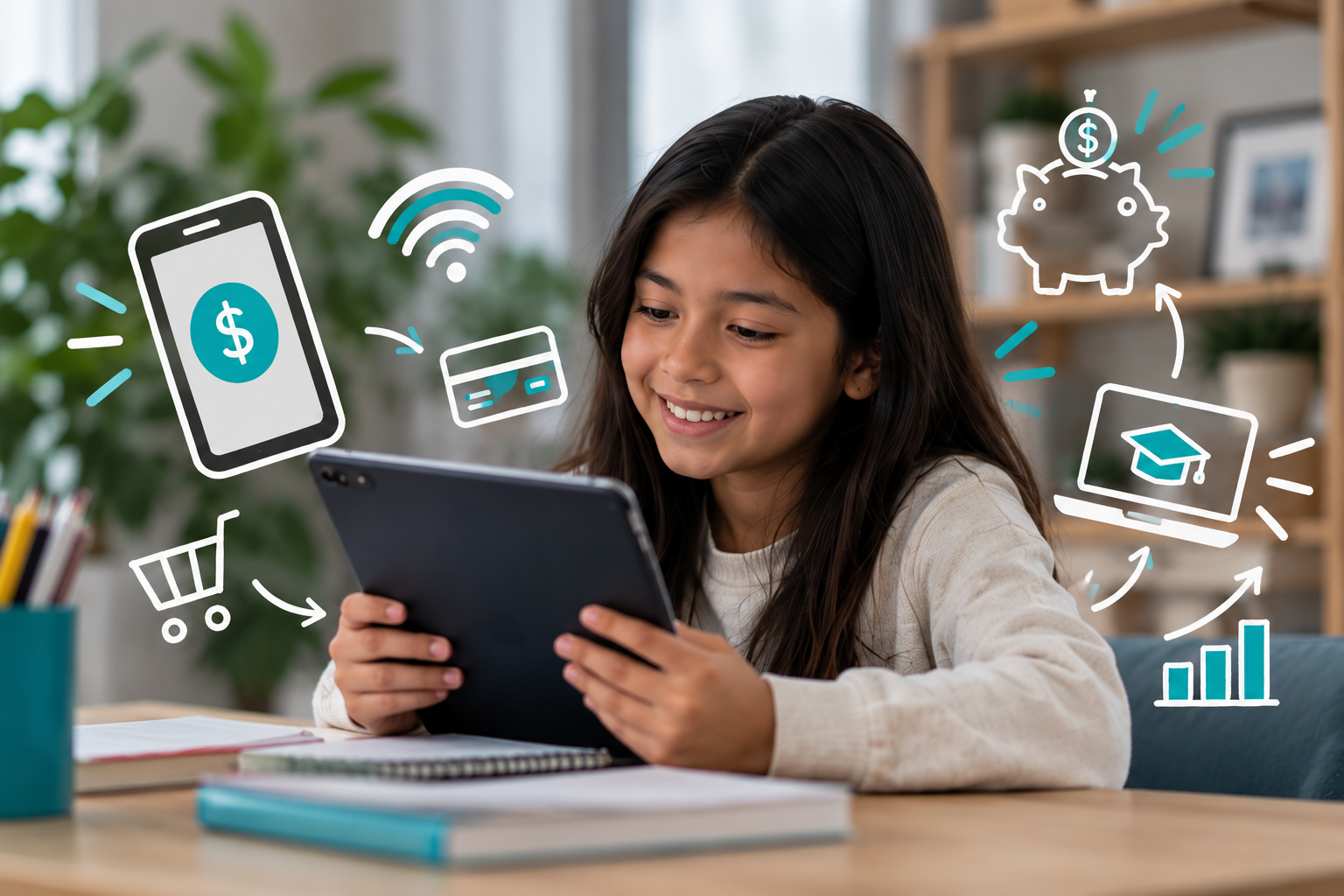
Today, many of our financial decisions happen from a mobile phone: we make transfers, shop online and use digital wallets.
That is why knowing how to manage money also means recognizing risks and protecting our information.
The 2026 survey found that:
These figures show that there are protection habits we can still strengthen. Knowing how to use a financial app is not enough: we also need to learn to identify warning signs, verify who is offering a product and take care of our personal data.
This is an especially important dimension for girls, boys and teenagers, who grow up using technology at ever younger ages.

Here we find one of the most relevant findings for those of us who believe in financial education from childhood.
The survey indicates that only 26% of adults took personal finance classes in secondary school. In addition, 38% talked with their parents about managing money during their childhood.
The report also shows an interesting association: among those who took personal finance classes in secondary school, 28% reach a high level of financial capability and 35% a high level of digital financial capability.
Among those who talked with their parents about managing money during childhood, 28% reach a high level of financial capability and 34% a high level of digital financial capability.
These figures do not prove, on their own, that a conversation or a class guarantees better financial capabilities. However, they do reinforce the importance of looking at what learning opportunities we are offering at school and at home.
Financial education does not have to begin when a person receives their first paycheck. We can talk about money when a girl decides how to use her allowance, when a boy saves to reach a goal or when a family plans a purchase.
These are everyday experiences that allow us to practice skills such as organization, patience, decision-making and weighing alternatives.
The results of this survey invite us to look at the challenge from different spaces. It is not a task that falls only on each individual.
We do not need to have all the answers to talk about money with our children. We can start by explaining simple decisions, setting family savings goals or inviting them to compare options before a purchase.
What matters is that they can take part, ask questions and learn from the consequences of their decisions in a safe environment.
Learning what saving is or what interest means is important. But financial education makes more sense when students can apply those concepts to real situations.
Starting a small business, organizing a budget for a project or comparing purchase alternatives are experiences that help connect knowledge with everyday life.
Organizations can also contribute through financial education programs for their employees, clear information about the products they offer and tools that help people understand the costs, risks and conditions of their decisions.
Strengthening financial education requires sustained efforts, educational resources and training opportunities for teachers and families. It also means promoting transparency and the protection of financial consumers.
The goal should not only be for people to know more concepts, but for them to be able to make informed decisions and build greater financial well-being.
The results of the SBS and CAF survey remind us that our relationship with money is built through knowledge, habits, attitudes and opportunities.
And although there are important challenges, there are also many ways to start changing this reality.
At Edufina we believe financial education can begin long before children have a bank account or receive their first paycheck. It begins when they learn to choose, organize their resources, set goals and understand that every decision has consequences.
That is why we want to keep bringing financial education to families and classrooms, with stories, activities and tools that allow learning by doing.
Now we want to hear from you: if you could drive one change to improve Peruvians’ relationship with money, where would you start: at home, in schools, in companies or in public policy?
The conversation is also part of the change.
Learn more about how we promote financial education from childhood at Edufina.
Thanks for reading,
Ara
October 22, 2026

October 22, 2026
October 22, 2026
Discover our workshops, storybooks and programs to bring financial education to your home, classroom or company.