

By Ara Layseca
October 22, 2026

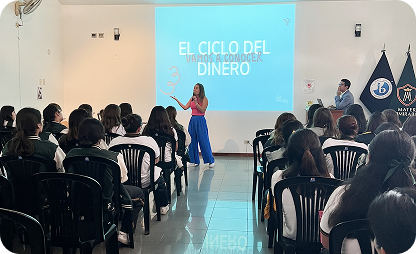
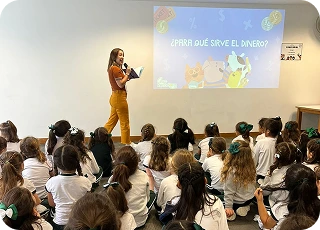
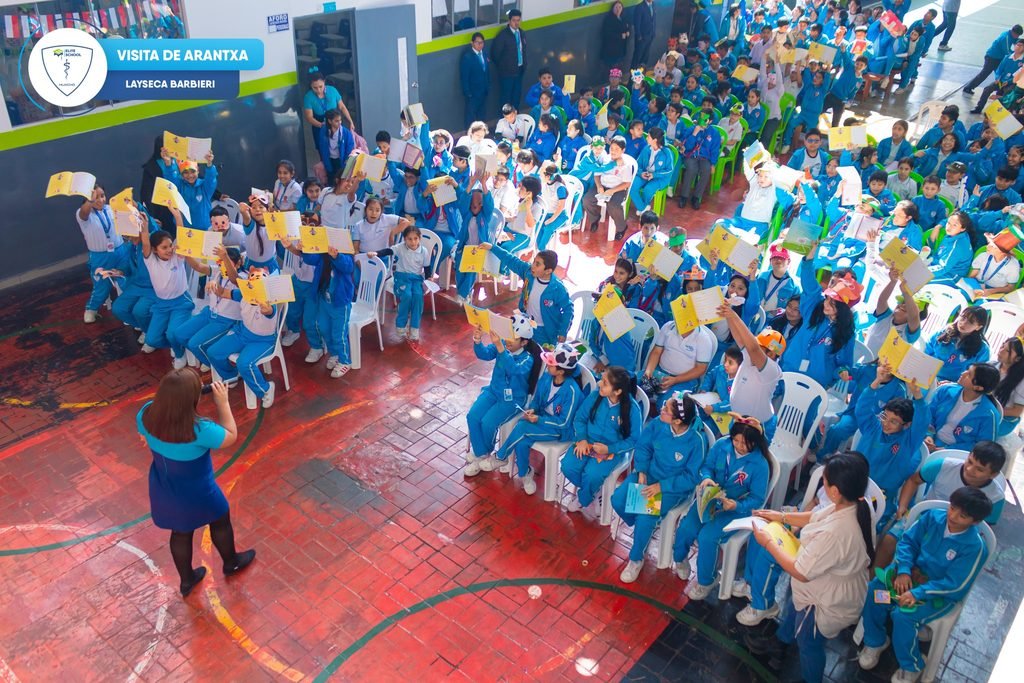
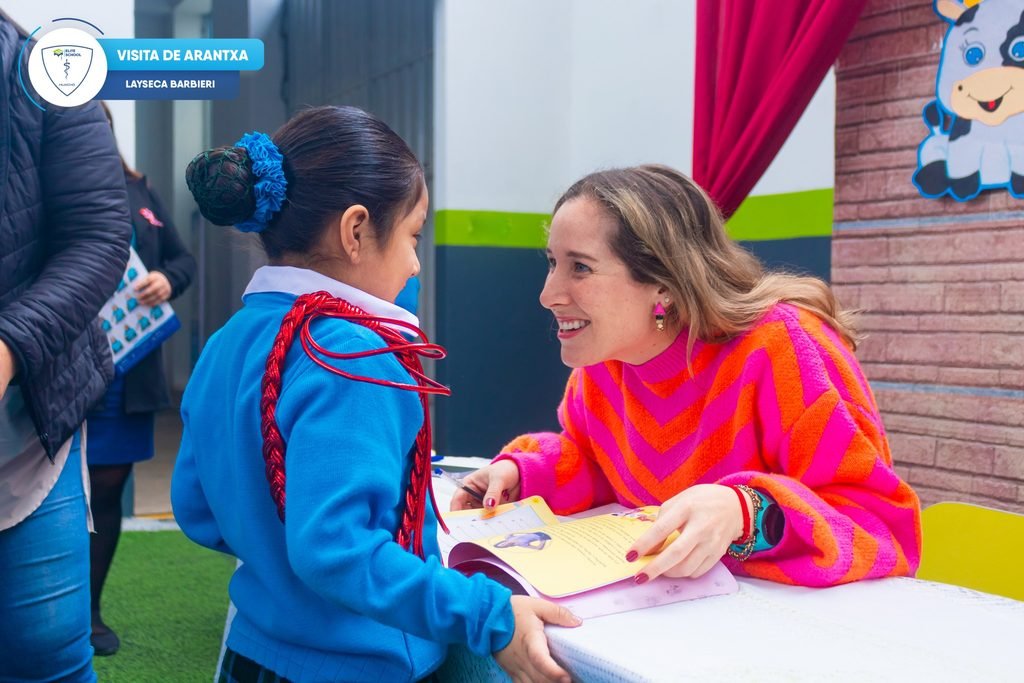
Our own photographs, from some of our school visits and our Teachers Program.
Financial education is reaching Peruvian classrooms with more force. But to teach children to make better decisions with their money, we first have to ask ourselves: how are we supporting teachers in this challenge?
For a long time, talking about financial education seemed like something reserved for adults.
Budgets.
Banks.
Credit.
Investments.
Debt.
But today we know that our relationship with money begins to be built much earlier.
It begins when a child receives their first allowance.
When they decide between spending or saving.
When they learn to wait.
When they tell apart something they need from something they simply want.
When they discover that their effort can create value.
And also when they learn to organize themselves, be grateful and share.
That is why financial education reaching the classroom is a huge opportunity.
But it also raises a question we consider fundamental:
Who supports teachers in taking on this new challenge?
In Peru, Law No. 31900 declared it a matter of national interest to incorporate into the National Curriculum for Basic Education content related to financial and tax education, accounting, economics and consumer rights.
Since then, the topic has been gaining space within the education system.
The Ministry of Education has developed guidance to support teaching practice related to financial and economic education. Its most recent materials propose working on the responsible management of economic resources from an active citizenship approach and offer recommendations for teacher mediation. Minedu Repository
And working with teachers is not entirely new either.
The SBS has been running financial education programs aimed specifically at teachers for years. Its program Finanzas en el Cole (Finance at School) seeks to help teachers build knowledge and, above all, become facilitators of financial capabilities for their students. SBS Peru
In fact, the SBS reported in 2021 that it had trained more than 20,000 teachers through this program since 2007. SBS Peru
This tells us something important: teacher training is a fundamental piece of financial education.
A teacher is not given only the responsibility of explaining a concept.
They have to make that concept meaningful to their students.
How do we explain saving to a 7-year-old?
How do we talk about needs and wants without turning the class into a list of prohibitions?
How do we teach budgeting to a teenager?
How do we talk about debt?
How do we bring in values such as responsibility, generosity and gratitude?
How do we connect these lessons with situations students experience outside school?
Financial education needs much more than a list of concepts. It needs pedagogy. And it needs teachers who feel confident bringing these topics into the classroom.
An important clarification is needed here.
We do not have a representative national measurement that lets us say what the level of financial education is among all Peruvian teachers.
However, there are specific studies that show why it is worth continuing to study and strengthen this topic.
A study carried out with 45 teachers at a school in Yantaló, Moyobamba, evaluated a financial education plan to improve their personal finances. Before the intervention, the research reported difficulties in areas such as income planning, budget management and saving habits. After the plan was implemented, the researchers found improvements in income planning, budget management and saving practice. Alicia
Another study, carried out with teachers at the Miguel Grau school in Juliaca, analyzed the relationship between personal finance management and level of debt, finding a moderate and significant positive relationship between the two. Again, this is a localized study, not a snapshot of all Peruvian teachers. UPEU Repository
What do these studies tell us?
Not that “teachers don’t know about finance.”
They tell us something much more interesting:
Teachers’ financial training deserves to be studied, strengthened and supported.
Because teachers are also people who make financial decisions.
And, at the same time, they carry the enormous responsibility of supporting others in building their own capabilities.
Sometimes, when a new educational challenge appears, we can fall into an unrealistic expectation:
“Now teachers also have to teach financial education.”
But we believe the question should be a different one:
“What do teachers need in order to do it well?”
They need clear content. They need tools. They need methodologies. They need to understand how children and teenagers learn at each stage. They need resources they can bring to the classroom.
And they also need a space to review their own relationship with money. Because teaching financial education is not just about passing on information. It also means supporting emotions, beliefs, habits and decisions.
At Edufina we believe good financial education should not produce children who simply know how to:
We want to raise people who are able to:
know themselves,
organize themselves,
make decisions,
wait,
plan,
value what they have,
be responsible,
be generous
and build a life that makes sense to them.
And that requires a pedagogical approach that goes far beyond a single class.
The SBS itself frames this role very clearly: its program Finanzas en el Cole seeks to train and raise awareness among teachers so they can become facilitators of financial knowledge and capabilities for their students. SBS Peru
And we share that vision. Because a book can reach a child. An activity can spark a conversation. But a prepared teacher can multiply that learning across dozens or hundreds of students.
A teacher can bring a conversation about saving to an entire classroom. They can turn a story into an activity. They can connect a financial goal with math. They can talk about entrepreneurship from a real experience. They can help a teenager question a financial decision. They can plant an idea that stays with a student for years.
That is why investing in teachers is investing in generations.
And perhaps this is the most important part of all.
Financial education is too big a challenge to fall on a single person.
It is not the responsibility of the school alone. Nor of the teacher. Nor of parents. Nor of the State. Nor of the organizations that work in financial education.
We need to work together.
The State can create policies and educational frameworks. Schools can create spaces to learn. Teachers can bring this knowledge into the classroom. Families can continue the conversations at home. And organizations like Edufina can create tools, content and programs that make all of this easier and more accessible.
At Edufina we want to contribute to this process by supporting those who stand in front of our children and teenagers every day.
We created our Teachers Program in Financial Education so that teachers and people committed to education can gain knowledge, methodologies and practical tools to teach financial education in a clear, dynamic way adapted to each school stage. Edufina Latam
The program has 5 modules that cover:
Self-knowledge, emotions and beliefs about money, saving, organization, goals and an introduction to investing.
Effort, reward, recognizing value, emotions and first notions of exchange.
Habits, saving, goals, generosity, gratitude, responsibility, collaboration and early entrepreneurship.
Budgeting, decision-making, income generation, saving, ways to safeguard money and an introduction to investing.
How children learn about money at each age, the beliefs we pass on and the role of the adult as a model and companion.
The program also includes printable guides, classroom activities, self-assessments, a teacher community and practical tools to bring what is learned into the educational experience.
We want teachers who know how to teach about money.
Teachers who can walk into a classroom and ask themselves:
What does this student need to understand?
What experience can I create so they discover it?
What tool can I use?
How can I connect this learning with their life?
And, above all:
How can I support them so they make better decisions in the future?
That is the kind of financial education we want to build. An education that does not begin and end with a definition. An education that turns into habits. Into conversations. Into decisions.
Into opportunities.
If you feel that financial education will become more and more important in your classroom and you want to prepare to take on this challenge with tools, methodology and support, we invite you to get to know our Teachers Program in Financial Education.
👉 DISCOVER THE EDUFINA TEACHERS PROGRAM
If we want to build a financially conscious generation, we have to do it together.
Thanks for reading,
Ara

October 22, 2026
October 22, 2026
October 22, 2026
Discover our workshops, storybooks and programs to bring financial education to your home, classroom or company.