

By Ara Layseca
October 22, 2026
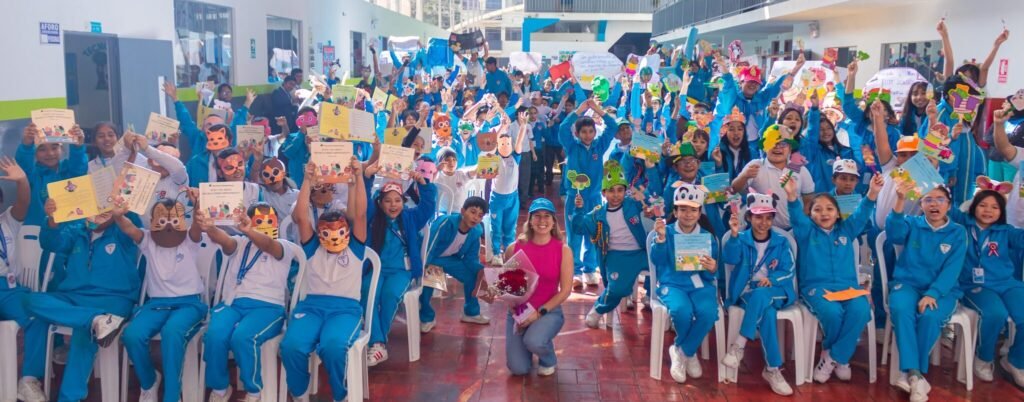
Photos from our visit to the Elite School campuses in Huaura.
What does it mean to teach financial education to children? Talking about saving? Teaching them to make a budget? Explaining what a bank is?
At Edufina we believe it starts much earlier.
It starts when a child wonders why something costs money. When they receive their first allowance. When they have to decide between buying something they want today or saving their money for a goal. When they discover they can use their talents to earn income. When they learn that sharing is also part of how we relate to money.
That is why, together with Editorial Eureka, we created Pequeños Financieros (Little Financiers), a collection of six storybooks starring Giver and his friends that accompanies children in their first steps into the world of financial education.
And today this topic is more relevant than ever.
In Peru, financial education is already part of the national education conversation.
In 2023, Law No. 31900 was enacted, declaring it a matter of national interest to incorporate into the National Curriculum for Basic Education content related to financial and tax education, accounting, economics and consumer rights.
In 2024, the Ministry of Education published a support document for teachers to promote economic and financial education in primary and secondary school. The document states that the goal is to help form financially responsible and critical citizens, mainly by developing the competency “Responsibly manages economic resources.”
And in September 2026, the Ministry of Education announced that financial education will be one of the topics considered in the curriculum update planned for 2026-2031. For now, the Government has said the topic will be incorporated, but it has not yet publicly detailed how it will be implemented, in which grades or with what materials.
For us, this confirms something we have believed since Edufina was born:
Financial education should not begin when a person receives their first paycheck. It should begin when they start making their first decisions.
And we have a reason to start early.
Research by David Whitebread and Sue Bingham of the University of Cambridge, on how habits and learning form in young children, found that by around age 7 children have already developed important capabilities related to handling money, such as understanding value, exchange and some concepts related to planning and self-control.
This does not mean financial habits are “set” at age seven or that it is too late to learn afterward. It means that childhood is an especially important stage for starting to build them.
And that is where stories come in.
Because children learn by talking, playing, observing and experimenting.
A concept like “saving” can seem abstract when we explain it as a definition.
But it becomes much easier to understand when Giver wants to get something, discovers he can’t buy it right away and has to decide what to do with the money he has.
Financial education then stops being a list of concepts and becomes a story.
In Pequeños Financieros, each book covers a different stage of the journey.
Children get to know money, learn to make decisions, discover saving, explore entrepreneurship, learn about generosity and finally understand that money can be a tool for getting closer to their dreams.
And each story includes practical activities and key words so that what was learned does not end when the book is closed.
The approach is simple:
Read → talk → practice → apply.
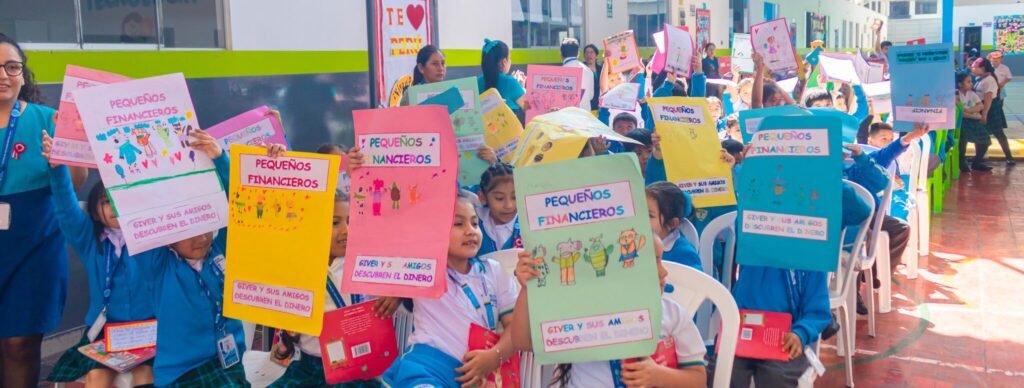
How do you explain to a child what money is?
At Edufina we want to do it using the language of the youngest: stories, characters and games.
In the first book of the collection, Giver and his friends take their first steps into the world of financial education.
Through a fun, illustrated story, they discover:
All explained simply and adapted to their age.
This is the starting point: before learning to manage money, we need to understand what it is.
And since each book includes practical activities, the conversation can continue after the reading, both at home and in the classroom.
This is the beginning of Giver’s journey.
“At what age should I start talking to them about money?”
“Do I give them a small tip or a regular allowance?”
“Is it okay for them to know how much I earn?”
These are questions many moms and dads ask themselves.
And talking about money with our children does not have to turn into a finance class.
It can start with something as everyday as their first allowance.
In the second story of Pequeños Financieros, Giver and his friends receive their first allowances and begin to discover that having money also means making decisions.
Through their adventures, children learn to:
The idea is not simply to teach them to “earn money.”
It is to begin teaching them what to do with it once they have it.
The book also includes activities and new words to review and talk about what was learned.
A child can learn perfectly well to add, subtract and solve equations.
But there is another question we should also ask:
Will they know what to do with their money when they are adults?
Talking about financial education in the classroom is much more than talking about numbers.
It also means talking about habits, emotions, decisions and well-being.
In Peru there is still an important gap. According to the National Financial Capability Survey by the SBS and CAF, carried out in 2022 and published in 2023, 41% of Peruvian adults did not reach a minimum level of financial capability, while only 13% reached an adequate level.
That is why we think it is important to start earlier.
In the third story of Pequeños Financieros, Giver and his friends learn to save.
But first they discover something fundamental:
to reach a goal, we need to make decisions about our money.
They learn to tell their needs from what they want, to identify which expenses they can adjust and to decide what to prioritize.
They also discover where they can keep their savings and get closer, in a simple, age-appropriate way, to concepts such as the savings account and returns.
Because saving is not simply saying:
“I’m not going to spend.”
It is learning to say:
“This is important to me and I’m willing to organize myself to get it.”
We cannot talk about economic development without also talking about the capabilities of the people who make up a society.
That is why teaching financial education also means helping children develop habits of organization, responsibility, creativity and perseverance.
In the fourth story, Giver and his friends face a new challenge:
starting their first business.
The story aims to convey a simple but powerful idea:
Our talents can become opportunities.
A business can be born from what we like, from something we know how to do or from a problem we want to solve.
Giver and his friends discover that to carry an idea forward they need creativity, motivation, organization and perseverance.
And they also begin to understand that earning money comes with responsibility.
Because starting a business is not just selling.
It is creating value for someone else.
Edufina was born with a mission:
to bring financial education to more children and families in Peru.
To date, we have distributed more than 7,000 storybooks and our financial education program is already present in more than 25 schools.
But from the beginning we were clear that our mission was not to raise children obsessed with having more money.
We want to raise financially conscious people.
People who can understand the financial system, make responsible decisions, save for their goals and use their resources in line with their values.
And also people who understand that money can be used to do good for others.
That is why, in the fifth book, Giver and his friends discover the value of generosity.
The story opens a conversation about sharing, helping and recognizing that our resources can also have a positive impact on other people.
Because a healthy relationship with money is not built only by learning to earn, spend and save.
It is also built by learning to give.
After going through the previous five books, Giver and his friends have already learned many things.
They have gotten to know money.
They have organized their allowances.
They have learned to tell needs from wants.
They have discovered saving.
They have started a business.
They have learned about generosity.
Then comes the most important question:
What is all this for?
The answer appears in the sixth and final book of the collection:
to fulfill our dreams.
Because money, rightly understood, is not the goal.
It is a tool.
A tool that, used with effort, organization and purpose, can bring us closer to what we truly want to build in our lives.
That is why the last book invites children to turn a dream into a financial goal.
To think about what they want to achieve.
To imagine how much they need.
To get organized.
To save.
And to discover that a goal that seems very big can start with a small decision made today.
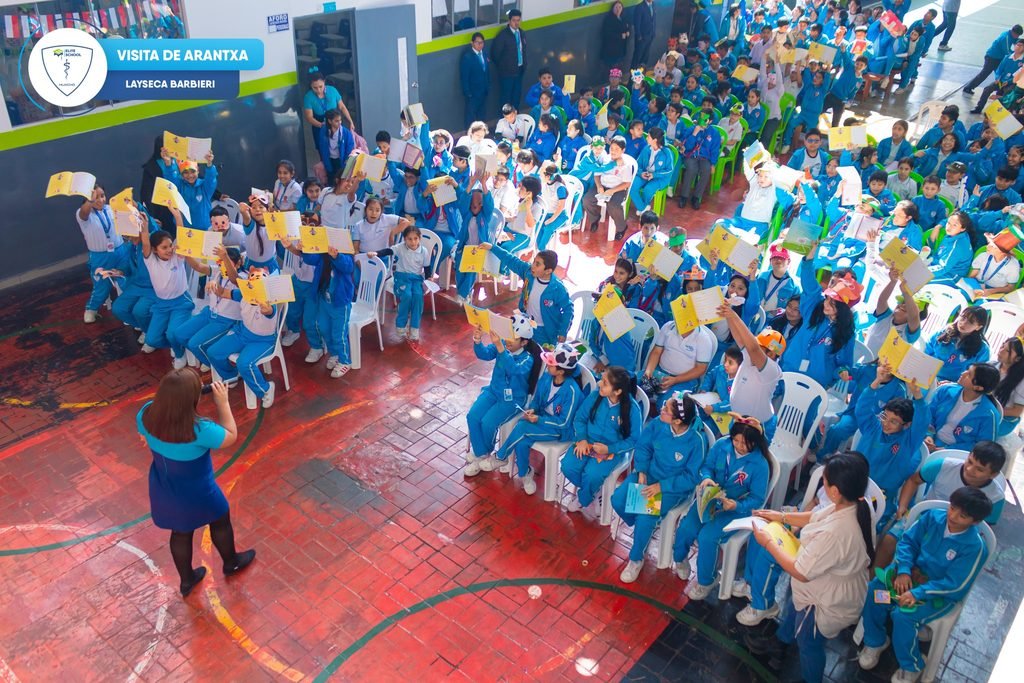
One of the things we care about most in Pequeños Financieros is that the education does not end when the story ends.
That is why our approach combines stories with activities.
Children can read what happens to Giver and his friends and then stop to think:
What would I do?
What would I choose?
What do I want to achieve?
How can I organize my money?
This way, the story becomes the starting point for a conversation between children, parents and teachers.
Because financial education does not need to happen only in front of a blackboard.
It can happen at home.
In the classroom.
In a store.
When we receive an allowance.
When we want to buy something.
When we make a list.
When we save money for a goal.
When we decide to share.
The best opportunities to learn about money are often in everyday decisions.
Today, the six books of Pequeños Financieros are part of Edufina’s financial education reading plan and are already being used in schools.
Our goal is for financial education to stop being a topic that appears only when students reach adolescence or start working.
We want children to be able to build, from an early age, a relationship with money based on:
knowledge + habits + decisions + purpose.
Because teaching them financial education does not mean teaching them to think only about money.
It means teaching them to make better decisions for their well-being and that of others.
Pequeños Financieros is designed to accompany children, families and teachers at different stages of their financial learning.
Six stories.
Six lessons.
One mission:
That our children grow up understanding that money is not an end, but a tool for building the life they want.
👉 Discover the 6 books of Pequeños Financieros on the Edufina website.
And if you are a teacher or represent a school and want to learn about our financial education reading plan, you can also write to us to get information on how to implement it at your institution.
Thanks for reading,
Ara

October 22, 2026
October 22, 2026

October 22, 2026
Discover our workshops, storybooks and programs to bring financial education to your home, classroom or company.